
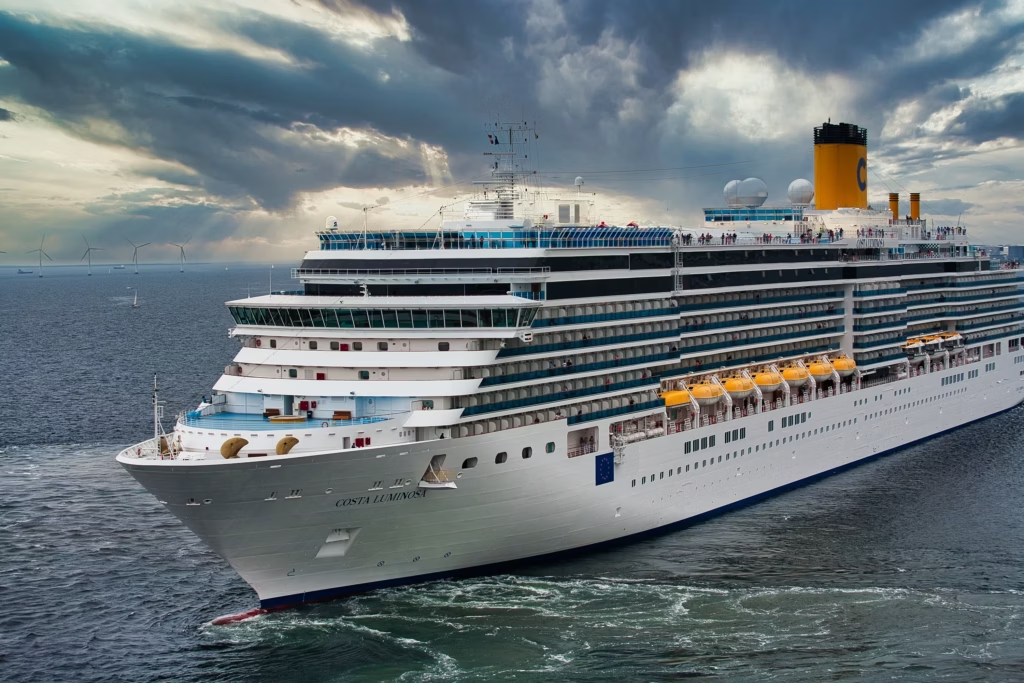
I recently had an opportunity to discuss safety protocols with a good friend of mine who was going on a Celebrity Caribbean cruise (as a celebrity).
The topic of personal safety came up and the discussion, naturally, progressed from there.
Context. I feel that the first thing to do when considering your safety on a cruise is to properly contextualize the environment. Cruise ships – especially the LARGE ones – are essentially floating cities. There are hundreds, possibly thousands (500-2,000+) of crew on board and many thousands (anywhere from a few hundred to upwards of 7,000 passengers). It’s a small, floating city, completely autonomous and self-contained. This creates a small microcosm of activity, and all the good and bad that can come with it. A cruise ship, like a small town, can have some predatory elements on board. They may come on board with the intention of victimizing others, or may do so through a combination of circumstance, opportunity and excessive substance use. Just like at a resort, being aware of your surroundings, your surrounding geography and various human elements can greatly reduce the risks you face while increasing your enjoyment.
As such, awareness and a general understanding of ship-centric protocols goes a long way in mitigating risks that come with taking a cruise. This is above and beyond the general travel safety we discuss in our book, TRAVELCRAFT – available HERE.
First off: Pre-departure planning. Ensure all your arrangements are booked well in advance. I recommend getting travel cancellation and interruption insurance because these ships don’t wait – if you’re late, you’re late, and they’re leaving. And they don’t turn back to get you. Your only option if you miss boarding is to meet the ship at the next Port Of Call (POC) and boarding then.
Make sure you share your itinerary with family or a trusted friend. Make sure you have copies and back-ups of all your identification, travel documents, itineraries, picture of the front/back of your credit cards and ensure you have local hard currency. It helps with tipping and small purchases when embarking.
Safety tip: Control your digital presence by turning off your geotagging function while travelling and don’t broadcast your location in real time. Post only after you have departed from a location to ensure no one can intercept you and target you for a crime. Be aware of backgrounds which may include your room number or items of interest in your room.
If travelling in or with a group, you should establish a group communication protocol, preferably independent of the ship’s wi-fi, and/or by using an encrypted messaging app. If you have mutual events you plan to attend together, set-up timings and locations where to meet, along with late or missed procedures to ensure everyone’s safety and that you can all check in on one another. Sharing each other’s room numbers is also prudent, as long as they stay within the group.
When booking, try to secure a cabin away from public thoroughfares, if possible, as this reduces the volume of passenger foot traffic past your cabin.
When initially boarding, keep your cabin number to yourself. “Loose lips sink ships”, in a sense, is also relevant here as broadcasting your cabin location may pique the interest of unsavoury elements. This is especially important if you are a woman (especially travelling alone) or a high-profile individual (such as a member of a group attending an on-board event or a celebrity trying to keep a low profile. If this information must be shared, make sure it’s don’t in a way that keeps it from listening ears and only amongst those in your party who need to know. Ensure that only the number of keys you want issued get issued – inform the check-in agent that you do/do not have a +1 and that no more ethanol “x#” of keys are to be issued. If it’s just you, make sure they know that you are alone and no other keys are to be given out to anyone BUT YOU.
Upon entering your cabin for the first time, (if you’re with a porter, ask them to wait) prop the door OPEN and check the room to ensure there isn’t anyone hiding somewhere. This also does double duty to ensure that, if there are any issues with the room that you can address them immediately before unpacking. Check that all the locks work properly, examine the locks and doors to your balcony and adjoining room (if applicable) and make sure that if there are partitions on your balcony separating you and your neighbours that they cannot easily be bypassed. If anything is amiss, leave the door propped open and call guest services and explain the issue. If a porter is there, show them what you mean and ask for immediate action to remedy the situation.
After dropping your bags, take some time and learn where your exits, must stations and life boats are located in relation to your cabin. In the event that you need to abandon ship, knowing how to get from your cabin to safety IN THE DARK can save your life.
Know these before departure, not after an incident starts:
- Location of nearest muster station and stairwell from your cabin
- Ship security office location and direct extension (not just “call the front desk”)
- Medical bay location and hours
- Your assigned lifeboat/muster station number
If you feel unsafe with a specific individual (crew or passenger), report to ship security immediately and follow up in writing/email — verbal-only reports can get lost in shift changes. Ships operate under maritime law, which affects how incidents are investigated; documentation matters more at sea than it typically does on land.
On-Ship Movement: ships, like modern towns, are laid out in a predictable way. It is also a 3-dimensional space where there are many levels. Think a hotel resort building that floats. When travelling to and from your room or events on board, learn both direct and indirect routes. Avoid predictable patterns and use different routes to go to and from your cabin as much as you can.
Use the Buddy System whenever you can. If you have a friend or family member with you, move around with them as often as you can. Be elevator and stairwell aware. If you are alone and enter an elevator and someone enters who makes you feel uncomfortable, step out immediately and take another one. Try not to confine yourself to spaces away from public view and from which escape is difficult.
Don’t assume that security on-board can do much for you after something happens. Though there are cameras on board, they may (or may not) be able to recall an event and yo can’t assume that they are monitored in real time. A vessel of that size is enormous and a small security force is not capable of providing “policing services” as you would imagine. Further, depending on the registration of the vessel and where in the world you are travelling, different laws and standards may apply.
Unlike some other environments, cruise ships carry with them unique risks and hazards in addition to the regular ones. The usual should be observed: be aware of your surroundings and situations, monitor and control your food and drinks to prevent spiking and keep control of your faculties. If you fall overboard, especially at night, your chances of survival are very low. Cruise ships cannot stop or turn around to find you, especially in the dark. Falls from height into water can be just like hitting concrete, so injury is highly likely. Stay safe, stay aware and ensure that you are always aware of your environment and its hazards.
One of the wonderful benefits of travel is meeting new people and experiencing new things. However, not everyone is benign. Be careful what you say out in the open and how much you share about yourself. Personal details about your life back home, your employment, family, etc, can all be weaponized by nefarious elements. If someone is particularly interested in your personal information, ask yourself why and don’t overshare. This is especially true if alcohol is a factor in the interaction. Trust pattern breaks. If someone’s story about their role, access, or reason for approaching you doesn’t add up, disengage first and verify second.
Excursions: doing cool stuff. Many cruise ships include optional excursions either off-ship or in a Port of Call. This removes you from the relative stability of the cruise ship and again, transfers you to a different environment of which you need to adjust. First thing: know how to get back to the ship and build in time buffers to get back. If you’re late they WILL LEAVE WITHOUT YOU! So don’t get left behind. If you are part of an organized land tour, ensure you are fully aware of the guide contact information, proposed route and timings. Reduce your profile by leaving as much “flash” behind on the ship as possible to reduce how much you stick out to locals as you can.
SUPPLEMENTARY SECTION FOR CELEBRITIES OR VIPs ON CRUISES:
*Don’t assume that shared security equals coordinated and effective security. Just because the cruise ship provides “dedicated” security does not mean that they are appropriately trained or invested in your safety.
*Get familiar with the walk-in/walk-out routine to attend events on-board. Establish your own boundaries and maintain them. There are appropriate times and places for fan interactions, and then there are the others. Firmly enforce your boundaries.
*During meet-and-greets and panel portions, ensure that there is a defined division between you and the fan line, with no one but approved team members behind the table with you. Ensure you are well aware of your exit points should something happen and you need to remove yourself. Don’t rely exclusively on cruise ship staff or security.
Do your best to delay your social media posts until you have returned from the tour or excursion. It adds a layer of control to your movements and personal security.
What to carry on-board for general personal safety – having a few items with you at all times will help reduce risks while increasing enjoyment.
| Item | Purpose / Notes |
| Personal alarm / whistle | Small, loud deterrent for cabin corridors, stairwells, or port-day situations |
| Portable door lock or door wedge alarm | Supplements cabin keycard lock; travels easily, works in any hotel or cabin |
| Small flashlight (with spare batteries) | Power interruptions happen at sea; also useful for stairwells and tender/port transfers |
| Portable phone charger (charged, TSA-compliant) | Keeps communication device active during outages or long excursion days |
| Copy of ID / passport (physical + digital photo) | Backup if original is lost, stolen, or held for onboard account setup |
| Emergency contact card | Onboard POC, land-based contact, embassy info, medical allergies — in a wallet, not just a phone |
| Cash in small denominations (local currency for ports) | Card systems can fail; useful for private transport in an emergency |
| Basic first aid kit (adhesive bandages, antiseptic, pain reliever) | Minor injuries without a medical bay trip |
| Prescription medications (original packaging, extra 3–5 day supply) | Covers itinerary delays or missed port stops |
Cruise Ship-specific additions:
| Motion sickness medication (e.g., meclizine, scopolamine patches, ginger chews) | Rough seas can hit without warning; performance and public appearances don’t pause for seasickness |
| Reusable door alarm / travel security wedge | Extra deterrent for cabin door, works even on decks with older lock hardware |
| Lanyard or crossbody bag for keycard | Keeps room access and ID on your person during performances and crowded events, reduces pickpocket risk |
| Waterproof phone pouch | Deck areas, tenders, and shore excursions involving water |
| Earplugs / eye mask | Adjoining cabins and engine noise can disrupt rest before performance nights |
| Refillable water bottle | Dehydration compounds motion sickness and fatigue on performance days |
| Non-slip sandals or deck shoes | Wet decks and stairwells are a common onboard injury source |
| Compact sewing kit / fashion tape / stain wipes | Wardrobe fixes without relying on ship services under time pressure |
| Printed muster station and deck map | Backup if phone is dead or WiFi/app access is down during an actual emergency |
One further thing to consider when on a cruise – if your cruise is stopping in several Ports of Call and they’re all different countries: MAKE SURE YOUR PASSPORT IS VALID for at least 6-months past your visit date AND your passport allows for travel to those countries without a visa. If your passport does require a visa, do the research prior to booking the trip so that you can either apply for the visa in advance or you can confirm that you can secure a visa when you arrive. Otherwise, you may not be allowed to disembark at the various Ports of Call for the excursions and tours. This is not the responsibility of the cruise line, but yours alone.
Another Pro Tip: depending on your circumstances, you may want to check out evacuation insurance in case you get sick and need to be medivac’d out or some sort of security situation erupts while on excursion, preventing you from leaving. We recommend looking into Global Rescue. See their coverage HERE.
Bottom line: get the lay of the ship, so to speak, as soon as you’re able when you come aboard. Stay aware of your environment and take steps to keep yourself safe. If something feels off, take steps to improve your position. Lastly, enjoy the serenity that comes from being away from land, light and the everyday. Stay safe, stay crafty and have fun!
Want to know more about travel safety? Check out or book, TRAVELCRAFT, available worldwide on Amazon.